
How a Name Turned Into a Meme and Disappeared
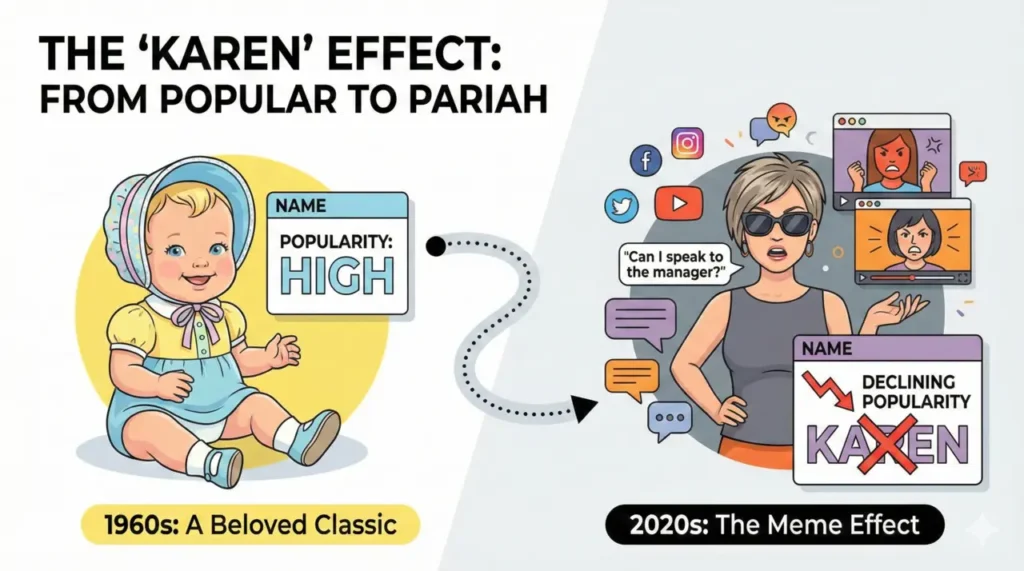
Back in the 1960s, “Karen” was the name everyone knew. The girl next door, your favorite teacher, your mom’s best friend, all Karens. In 1965, it ranked as the third most popular name in America. It felt classic, solid, and everywhere.
Jump ahead to the 2020s, and “Karen” is no longer just a name. It is an insult, a joke, a costume, and a meme. If you search “Karen” on Google today, you will not find stories about friendly neighbors or its Danish roots, which actually mean “pure.” Instead, you will see viral clips of women arguing with store managers, confronting neighbors, or causing public scenes.
Sociologists call this shift “The Karen Effect.” It describes what happens when a name becomes so closely tied to a negative stereotype that parents stop using it altogether.
But is this just a cultural vibe, or is it really happening? Are memes powerful enough to erase a name that has existed for centuries? We looked at the data to find out.
(Want to know how your own name is doing? Whether it is rising, stable, or heading toward meme territory, you can check with our Name Popularity Tool.)
The Data Behind the Karen Nosedive
For decades, “Karen” was unstoppable. According to Social Security Administration data, it stayed in the Top 10 throughout the 1950s and 1960s. Even as naming trends shifted, it remained a reliable, familiar choice.
Then the internet arrived.
The phrase “Can I speak to the manager?” began circulating on Reddit around 2014. By 2019, the meme had gone mainstream. During the pandemic in 2020, it exploded.
Here is what followed:
2019: Karen ranked at number 660 on the baby name charts 2020, the meme peak: it dropped to number 831, one of the steepest declines ever for a long established name 2021: for the first time in nearly a century, Karen did not appear in the Top 1,000 at all
The raw numbers tell an even harsher story. In 1965, nearly 33,000 baby girls were named Karen. By 2021, fewer than 350 were.
This was not a slow decline. It was a sudden collapse. Parents did not gradually move away from the name. They abandoned it to avoid the teasing and stigma that came with the meme.
Name Poisoning and Internet Speed Stigma
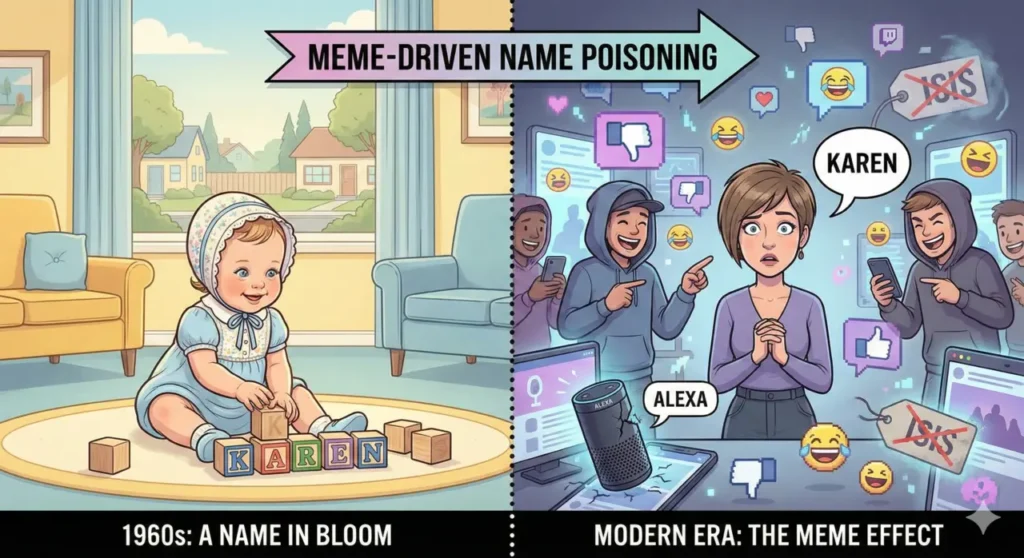
Linguists refer to this phenomenon as “Name Poisoning.” It happens when a name becomes so strongly linked to something negative that it can no longer be separated from that association.
This has happened before, but usually over long periods of time. “Benedict” fell out of favor after Benedict Arnold, but it took decades. “Adolf” disappeared for obvious and horrific reasons.
Today, it happens at internet speed. One viral clip, one hashtag, and a name can be ruined almost overnight.
The Playground Test
Parents often choose names by imagining their child at school. Will this name make them stand out in a good way, or turn them into a target?
With “Karen,” the answer became painfully clear. The meme is everywhere. Even children know what it means to “be a Karen.” Few parents are willing to risk that kind of social baggage for their child.
It Is Not Just Karen
The internet has turned naming into a minefield. One viral moment can permanently change how a name is perceived.
The Alexa Effect
Before 2015, Alexa was a rising star. It was a fresh, friendly variation of Alexandra and ranked in the Top 50 for years.
Then Amazon released the Echo.
Suddenly, calling your child’s name could activate a smart speaker. By 2019, the number of babies named Alexa had dropped by more than half. The name shifted from a person to a voice command.
The Isis Collapse
Isis was once the name of a powerful Egyptian goddess associated with strength and healing. It was unique, historical, and meaningful.
When ISIS, the terrorist organization, dominated global headlines around 2014, the name vanished almost overnight. Parents were no longer worried about teasing. They worried about discrimination, security checks, and lifelong stigma.
The Katrina Effect
Natural disasters can damage names as well as cities. Before August 2005, “Katrina” was stable and even appealing. After Hurricane Katrina devastated New Orleans, parents avoided the name almost immediately. Usage dropped by about 40 percent the following year.
Names associated with tragedy rarely recover quickly. The name “Titanic” was never common, but after the disaster, it became culturally untouchable for decades.
The Gender Gap: Why Chad and Kyle Survived
This is where things get especially interesting. Male names are not immune to memes. “Chad” is often portrayed as the arrogant alpha male. “Kyle” is stereotyped as the energy drink fueled troublemaker.
Yet Social Security data shows that while these names have declined, they did not collapse the way “Karen” did.
Sociologists suggest this comes down to how memes target women versus men. The “Karen” meme attacks character by portraying women as entitled, shrill, and unlikable. That kind of stigma is socially devastating.
By contrast, being called a “Chad” can sometimes even be flattering. It can imply confidence, popularity, or attractiveness. No one uses “Karen” as a compliment.
There is also tradition at play. Parents tend to hold onto boys’ names longer, especially family names and classics. Girls’ names are treated more like fashion. When a name feels outdated or tainted, it is abandoned more quickly.
Can a Forgotten Name Recover?
So is “Karen” gone forever?
History suggests names follow something like a 100 year cycle. It often takes three or four generations for a name to feel fresh again. That is why names like Ethel and Mildred still sound old fashioned, while Olive, Hazel, and Violet feel modern again.
For Karen to return, the meme would need to fade completely. The cultural image would need to disappear. Realistically, that will not happen soon. The meme is deeply embedded in internet culture and endlessly recycled.
Karen is likely stuck in naming limbo for decades.
The Future of Baby Naming
This is the new reality of naming children. Parents now Google names before using them. It is no longer just about playground rhymes. It is about memes, technology, and politics.
Names like Siri and Cortana are effectively unusable. Political associations have caused names like Donald to drop sharply. Names like Elon rise and fall depending on headlines and public sentiment.
Conclusion: The Power of the Crowd
The story of “Karen” is more than a meme. It shows that names do not belong only to individuals. They belong to culture.
A joke that started online erased a name that had been used for centuries. If you are named Karen, this is not a judgment on you. History suggests things eventually change. But for now, the name carries the weight of a very strange moment in internet history.